A well-designed office is more than just a place where people work. The layout, entrance, seating arrangement, lighting, workspace organisation and overall environment can influence how employees experience the workplace and how efficiently a business operates.
Vastu Shastra is a traditional Indian architectural and spatial planning system that considers directions, elements and the arrangement of spaces. Many business owners use Vastu principles when designing or reorganising offices, commercial spaces and workplaces.
When applied thoughtfully, Vastu for office and business growth can be used as a framework for creating an organised, comfortable and positive working environment.
However, Vastu should complement practical business decisions rather than replace them. Location, business strategy, financial planning, customer service, employee management and product quality remain essential to business success.
Vastu for office refers to the traditional application of Vastu Shastra principles to workplace design and layout.
It may consider factors such as:
The objective is to create a workplace that feels balanced, functional and well organised.
Instead of changing everything in an existing office, businesses can also consider practical Vastu adjustments that work with the current structure.
Business owners often consult Vastu specialists when they are:
Traditional Vastu considers different directions and elements to have different associations. A Vastu consultation therefore looks at the complete layout rather than recommending the same solution for every business.
The main entrance is one of the first areas considered in office Vastu.
The entrance should ideally be:
Avoid allowing the entrance to become a storage area for boxes, unused equipment or other materials.
A clean entrance also has an obvious practical benefit: it creates a better first impression for clients, employees and visitors.
For an existing office, changes should be made only after considering the actual floor plan and structural limitations.
The reception area creates the first impression of your business.
From a Vastu perspective, the placement and direction of the reception desk may be considered according to the office layout.
From a practical perspective, the reception should provide:
A clean and organised reception can make an office feel more professional even without major structural changes.
For many businesses, the owner’s cabin is an important part of the office.
Traditional Vastu practices often pay particular attention to the direction and placement of the business owner’s cabin and desk.
The exact recommendation should depend on:
Rather than applying a universal rule, a professional office Vastu consultation can evaluate the complete layout.
The direction in which the business owner sits is another commonly discussed Vastu factor.
Traditional Vastu practitioners may recommend specific seating orientations depending on the person’s role and the layout of the office.
The desk should also ideally allow the owner to work comfortably without excessive distractions.
Practical considerations such as natural light, screen glare, ventilation and privacy should be considered alongside Vastu principles.
The North-East area is traditionally considered significant in Vastu Shastra.
Many Vastu practitioners recommend keeping this area:
Heavy furniture, unused equipment and unnecessary materials should not be placed there without considering the complete layout.
For an existing office, avoid major structural changes based solely on generic online advice.
The South-West zone is traditionally associated with stability and grounding.
In office Vastu, heavier furniture or important workspaces may be considered for this area depending on the layout.
However, the ideal arrangement varies according to the office structure and the business owner’s requirements.
A complete floor-plan assessment is therefore more useful than following a single directional rule.
Employees spend many hours at their desks, so workstation design matters.
A productive workstation should have:
Vastu practitioners may also consider the direction employees face while working.
However, comfort and ergonomics should always remain a priority.
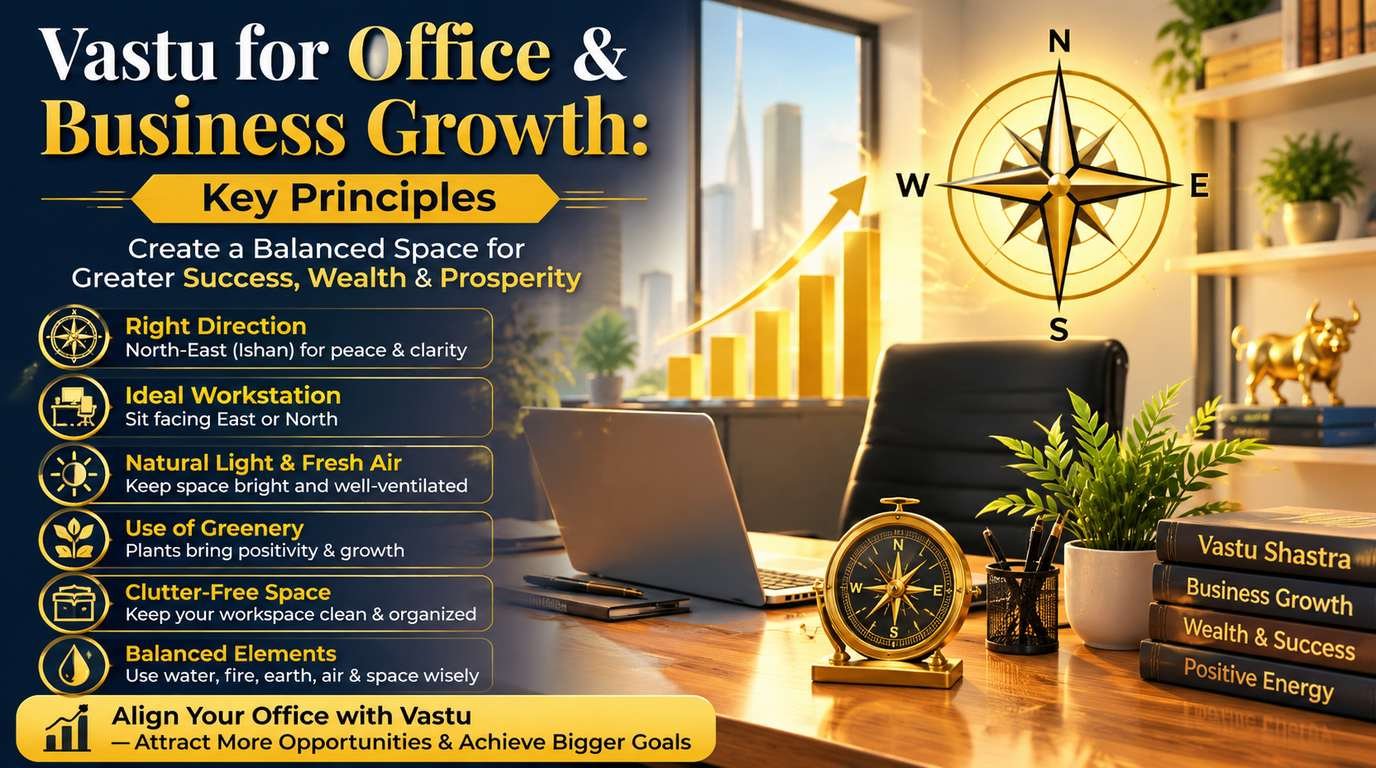
One of the simplest principles that fits both Vastu and modern workplace design is organisation.
Avoid allowing the office to accumulate:
A clutter-free environment makes it easier to work and maintain the office.
This is one Vastu recommendation that can usually be implemented without major expense.
Different departments may have different functional requirements.
The accounts area handles financial records, invoices and important business information.
Traditional Vastu consultations may consider its direction and placement carefully.
More importantly, the department should have:
Vastu should complement these practical requirements rather than replace them.
A conference room should support communication and decision-making.
Consider:
Vastu principles can be considered while planning the seating direction and location of the room.
Storage should be organised instead of allowing unused materials to spread across the office.
Heavy materials are traditionally considered more suitable for certain zones, particularly the South and West areas, depending on the overall plan.
The most important practical rule is simple: do not allow storage to block entrances, walkways or emergency exits.
If your goal is to use Vastu as part of your office planning, consider these basic principles:
Regular cleaning helps maintain an organised workplace.
Remove broken or unused items.
Where possible, allow natural light into working areas.
Fresh air can improve workplace comfort.
The owner’s cabin, reception and accounts department should remain particularly organised.
Choose professional colours that suit the business environment and don’t create visual fatigue.
Computers, servers, wiring and electrical equipment should be installed safely and professionally.
The entrance should look clean and welcoming.
Vastu is traditionally believed to influence the energy and balance of a space, and many business owners consult Vastu practitioners for office planning.
However, it is important to maintain realistic expectations.
Vastu alone cannot guarantee business growth, higher revenue or financial success.
Business growth depends on many factors, including:
Vastu can be considered as one part of a broader approach to creating a positive and organised workplace.
This people-first approach is also more appropriate from an SEO perspective than making exaggerated promises such as guaranteed wealth or guaranteed business success.
Every office is different.
A recommendation that works for one building may not be suitable for another.
Do not demolish walls or move important infrastructure simply because of a generic Vastu tip.
First understand the actual issue and explore practical alternatives.
Vastu should never come at the expense of employee comfort and safety.
A professional consultation should provide constructive guidance rather than making business owners afraid of certain directions or objects.
More remedies do not automatically mean better results.
A qualified practitioner should recommend only those measures considered relevant to the individual’s situation.
Online Vastu tips can provide general information, but an actual office has its own:
Therefore, a personalised consultation can be more useful than applying a generic checklist.
A Vastu consultant can review the existing layout and identify possible improvements without necessarily recommending major structural changes.
If you are planning a new office, consider Vastu before construction or interior design begins.
This gives you more flexibility to plan:
Early planning can also reduce the need for expensive modifications later.
You do not necessarily need to relocate your business because the current office does not perfectly match a Vastu checklist.
Many existing offices can be reviewed and improved through practical adjustments.
These may include:
The correct approach depends on the actual floor plan.
Athaarv Guruji provides astrology and Vastu-related guidance based on individual requirements.
For business owners planning a new office or trying to improve an existing workspace, a personalised consultation can help review the office layout and identify areas that may be considered from a traditional Vastu perspective.
Instead of applying random online remedies, a consultation can focus on the specific structure and requirements of the business.
If you are planning a new office, relocating your business or redesigning your workplace, consider getting the layout reviewed before making major changes.
Vastu for office and business growth can be considered as a traditional approach to creating a balanced and organised workplace.
The most useful principles are often simple: maintain cleanliness, reduce clutter, create comfortable workspaces, improve lighting and ventilation, and carefully consider the placement of important office areas.
At the same time, Vastu should not be presented as a guaranteed solution for business problems. Successful businesses require good planning, strong products or services, effective marketing, financial discipline and customer-focused operations.
If you want to incorporate Vastu into your business environment, a personalised assessment of the office floor plan can provide more relevant guidance than generic online tips.
There is no single direction that is universally best for every office. The ideal arrangement depends on the entrance, floor plan, business type, owner’s requirements and placement of different departments.
Traditional Vastu gives importance to different directions for different purposes. North, East, North-East and other zones may be assessed depending on the office layout rather than applying one universal rule.
The recommended seating direction can vary according to the person’s role, office layout and traditional Vastu principles. A complete floor-plan analysis is preferable.
Vastu is traditionally believed to support a positive and balanced environment, but it cannot guarantee business growth. Business performance also depends on strategy, customers, finances, products and management.
Yes. Many Vastu principles can be considered through furniture placement, organisation, lighting and other practical adjustments without making major structural changes.
For basic principles, general information can be useful. For a complete office layout, a personalised consultation can provide more specific guidance based on the actual floor plan.
Not necessarily. Before relocating or making expensive structural changes, consider a professional assessment and practical alternatives.